Seamless vs. Welded Steel Pipe: Key Differences in Manufacturing, Working Pressure, Sizes & Procurement Guide
Seamless Pipe (No Seam, Extreme Pressure) vs. Welded Pipe (High Efficiency, Large Diameter, Cost Advantage)
Seamless steel pipes are forged and pierced from solid cylindrical steel billets without any joint or longitudinal weld seam, delivering uniform 360-degree circumferential hoop stress resistance for extreme pressure, high-temperature, and corrosive service. Welded steel pipes (ERW, LSAW, SSAW) are formed from hot-rolled steel strip or plate with a welded longitudinal or spiral seam, offering superior concentricity, tight wall tolerances, unlimited large diameters (up to 100 inches), and unbeatable cost economy for fluid transmission and structural engineering.
When specifying tubular products for industrial contracts, procurement teams must balance structural safety against strict cost containment. Standard specifications such as API 5L Line Pipe and ASTM A53 Carbon Steel Pipe encompass both seamless and welded manufacturing options. Understanding the exact mechanical boundaries, pressure reduction factors, dimensional limitations, and inspection protocols is essential for sound project execution.
1. How Seamless Steel Pipe is Made (Manufacturing & Metallurgy)
Seamless steel pipes, governed predominantly by API 5L and ASTM A106 Grade B standards, originate from solid, continuously cast cylindrical billets. The metallurgical manufacturing process follows three primary routes depending on finished diameter and dimensional tolerance:
- Hot-Rolled Piercing Process: Round steel billets are heated in a rotary hearth furnace to approximately 1,200°C - 1,280°C. A piercing point is driven into the billet center while two opposing barrel-shaped rolls compress and rotate the material, forming a hollow shell. This shell is then elongated via multi-stand mandrel mills, sized, cooled, and straightened. This method is predominantly used for medium-to-large diameter heavy wall pipes.
- Cold-Drawn & Cold-Rolled Process: To produce precision small-diameter tubes, thin-wall hydraulic tubing, or heat exchanger tubes (such as ASTM A179 and ASTM A192), hot-rolled hollow shells undergo chemical pickling, phosphating, and are pulled cold through tungsten carbide dies. This process yields ultra-smooth interior/exterior finishes and tight dimensional tolerances.
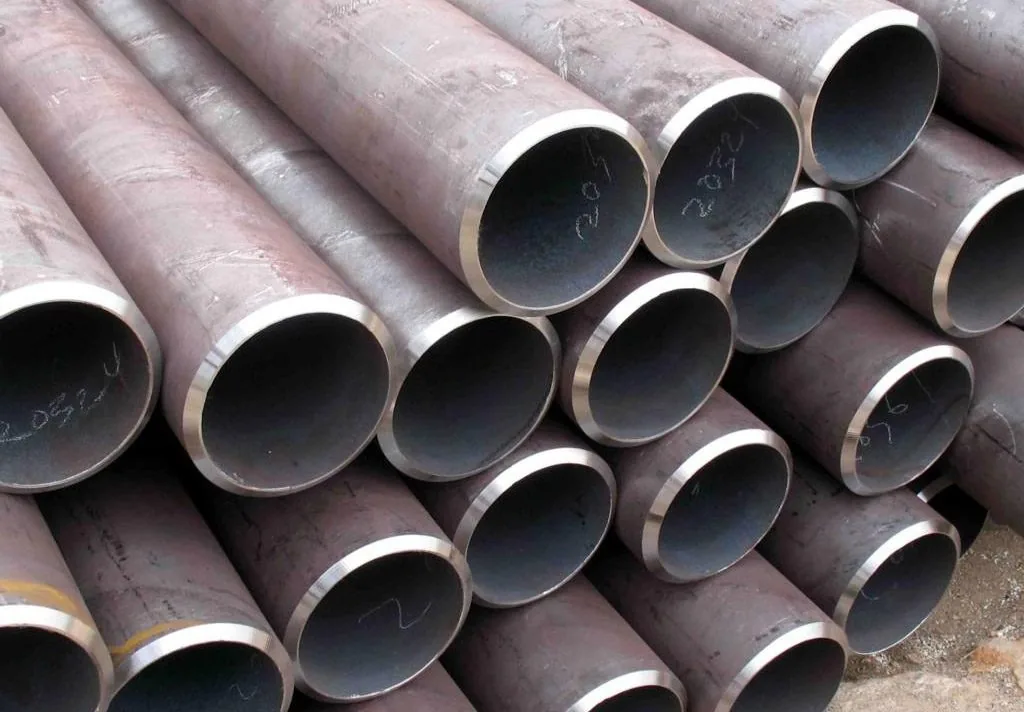
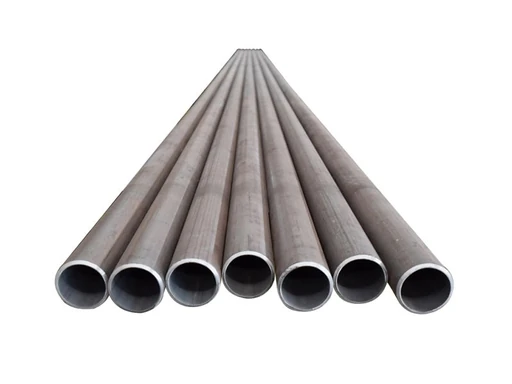
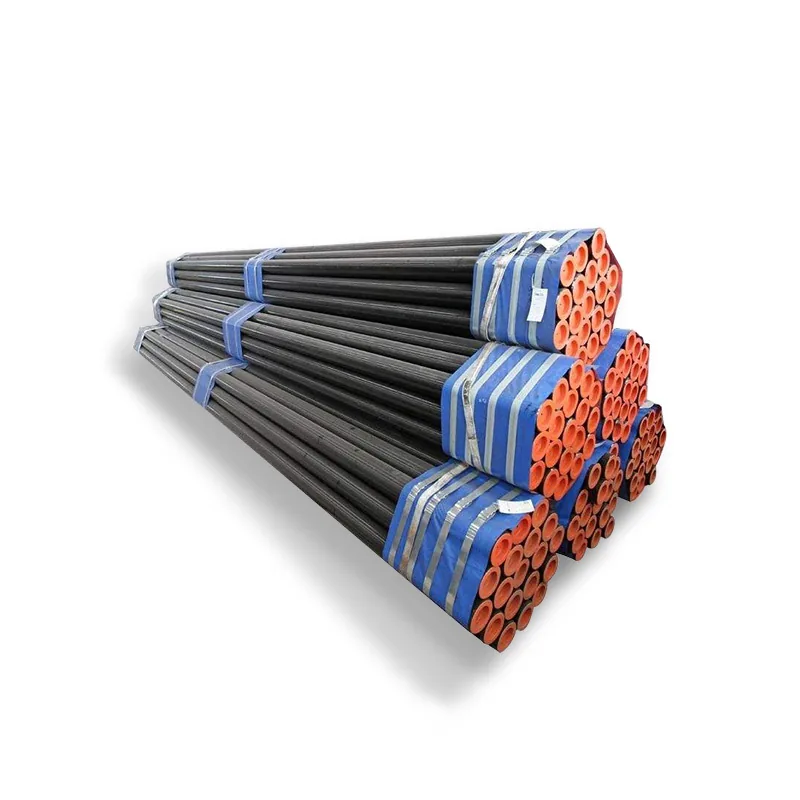
Figure 1: Heavy-duty seamless carbon steel pipes bundled with protective end bevel caps ready for export staging
Why Source Seamless Steel Pipes from Ironex China?
At Ironex China, we maintain an extensive ready-stock inventory of prime seamless carbon steel pipes, including ASTM A106 Gr. B, API 5L Gr. B / X42 / X52 / X65, ASTM A335 (P11, P22), and ASTM A179/A192 boiler tubes. Our seamless pipe sizes range from 1/2" to 24" OD (with hot-expanded capabilities up to 36"), covering full wall thicknesses from SCH 10 through SCH 160 / XXS. Every pipe undergoes rigorous 100% hydrostatic testing, eddy-current and ultrasonic inspection (UT), and is accompanied by authentic EN 10204 3.1 Mill Test Certificates. Explore our Seamless CS Pipe Catalog or contact us today for mill-direct wholesale container pricing.
2. How Welded Steel Pipe is Made & The Three Main Technologies
Welded steel pipes are manufactured from flat rolled steel plates or continuous slit coils. Through progressive mechanical deformation, the flat substrate is shaped into a circular or rectangular profile, and the abutting edges are permanently fused. The three dominant welding processes are:
1. ERW (Electric Resistance Welded)
Continuous hot-rolled steel strip is progressively bent into a tubular shape through roller dies. High-frequency electrical current (HFW, 300–500 kHz) induces localized melting at the joint edges, which are forged together under heavy squeeze rolls without filler metal. ERW delivers high production speed, smooth internal deburred finish, and exceptional dimensional uniformity.
2. LSAW (Longitudinal Submerged Arc)
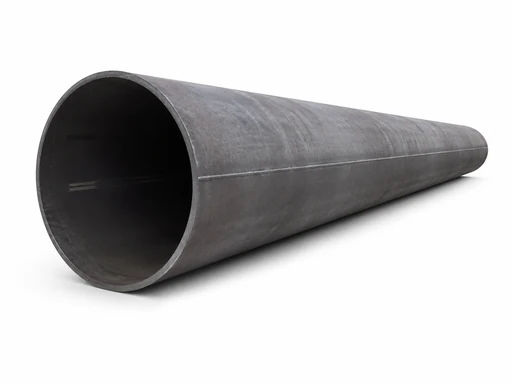
Manufactured using individual heavy steel plates formed via JCOE or UOE hydraulic press presses. The seam is joined with double-sided submerged arc welding (internal and external passes) with wire and granular flux. LSAW is the premier choice for thick-walled, large-diameter (16" to 56" OD) high-pressure oil and gas trunk transmission pipelines.
3. SSAW (Spiral Submerged Arc Welded)
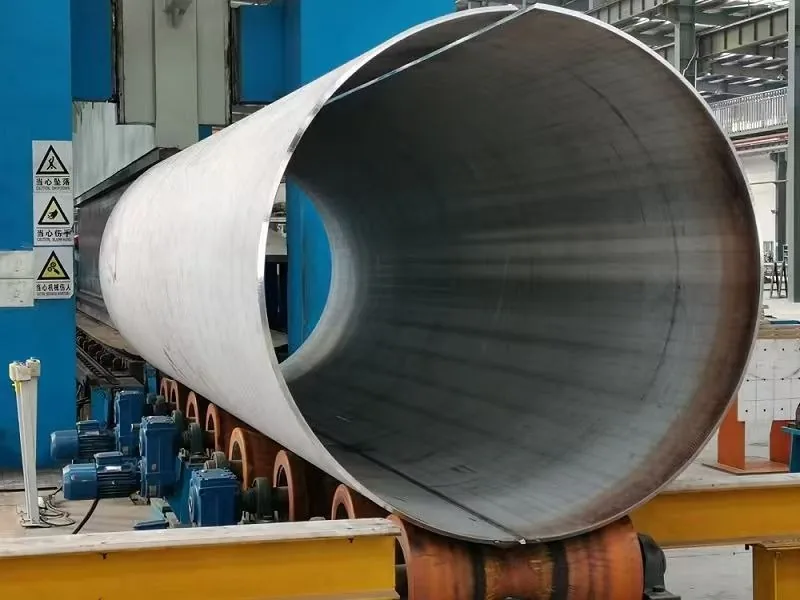
Formed by bending steel coils continuously at a calculated spiral angle, allowing a single narrow strip width to produce a broad spectrum of large-diameter pipes (up to 100" / 2,540 mm). Joined via submerged arc welding, SSAW pipes provide unparalleled cost economy for long-distance water transmission, sewer mains, and civil foundation pipe piling (ASTM A252).
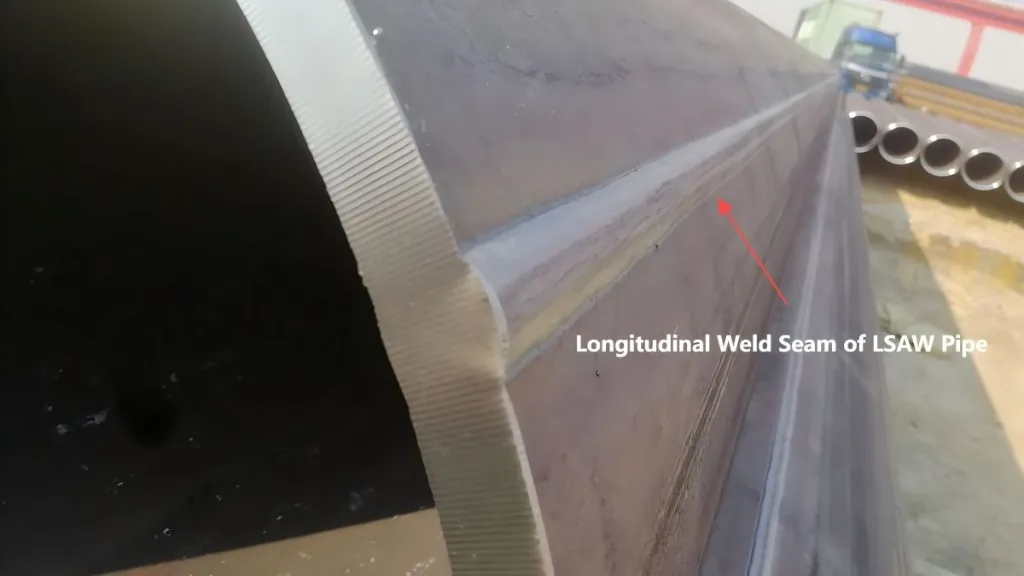
Why Purchase Welded Steel Pipes from Ironex China?
As an international mill exporter, Ironex China supplies certified ERW, LSAW, and SSAW welded pipes manufactured to API 5L (PSL1/PSL2 Gr. B to X80), ASTM A53, ASTM A252, and EN 10219 (S235/S355). We feature automatic ultrasonic testing, full-length seam X-ray radiographic inspection, and advanced hydraulic testing to guarantee 99.8% first-pass weld integrity. In addition, our processing center provides external 3PE / 3PP, FBE anti-corrosion coating, internal epoxy lining, beveling, and hot-dip galvanizing. Sourcing welded pipes directly from Ironex offers overseas EPCs 15% to 25% cost savings with rapid ocean breakbulk or container delivery. View our Welded Pipe Portfolio or request a project quotation today.
3. Why Engineers Prefer Seamless Pipes: Safety Factor & Stress Homogeneity
The primary justification for specifying seamless steel pipe over welded pipe centers upon extreme pressure containment and risk mitigation. Because seamless pipe is extruded as a single metallurgical entity from a solid billet, it possesses identical tensile strength, yield behavior, and grain alignment around its entire 360-degree perimeter.
In contrast, even with state-of-the-art welding and post-weld heat treatment (PWHT), the weld seam represents a metallurgical transition zone (Heat Affected Zone or HAZ). Under cycling dynamic pressure, thermal expansion spikes, or sulfide stress cracking (H2S environments), microscopic micro-voids or weld inclusions could act as stress concentrators.
According to Barlow's formula:
Where P = Internal Design Pressure, S = Allowable Stress, t = Wall Thickness, D = Outside Diameter, and E = Longitudinal Weld Joint Factor. For seamless pipe, E = 1.00 (full 100% credit). For welded pipe, standard piping codes enforce E = 0.85 (unless 100% radiographic examination is performed). Consequently, welded pipe requires roughly 15% to 20% greater wall thickness to withstand identical design pressures, often equalizing material tonnage costs!
Piping Engineering Consultation & Material Optimization by Ironex
Not sure whether your system parameters dictate seamless or welded pipe? Our technical sales engineering team at Ironex China provides complimentary pipeline sizing and specification review. By evaluating operating pressure, fluid corrosiveness, design temperature, and budget boundaries, we assist EPC engineering teams in selecting the optimal configuration—saving tens of thousands of dollars while maintaining zero-compromise safety margins. Consult our engineering department for direct technical guidance.
4. Five Key Practical Differences: Seamless vs. Welded Pipes
When comparing both products on the staging yard, five observable factors differentiate seamless from welded tubular products:
1. Surface Appearance & Concentricity
Welded pipe inherits the immaculate surface quality and tight gauge tolerances of hot-rolled or cold-rolled steel coils. Wall thickness is exceptionally uniform across the entire pipe circumference (tolerance within ±0.05 mm), resulting in superior concentricity and internal flow dynamics. Hot-finished seamless pipes, by contrast, may feature minor longitudinal roll scale, shallow surface pits, or slight wall eccentricity inherent to billet rotary piercing.
2. Available Diameter Range (Size Limits)
Because seamless pipe depends on billet piercing presses, standard original rolling mills in China and globally are economically limited to a maximum outer diameter of 20 inches to 24 inches (508 mm to 610 mm). Expanding beyond 24" requires secondary thermal induction hot-expansion (which slightly degrades grain density). Welded pipes experience no such physical restriction: LSAW and SSAW processes effortlessly roll and weld pipes up to 100 inches (2,540 mm OD) with wall thicknesses exceeding 50 mm.
3. Operating Temperature & Dynamic Fatigue
In high-temperature thermal power plants, heat recovery steam generators (HRSG), and cryogenic environments (ASTM A333), seamless pipes reign supreme. They withstand intense cyclic thermal expansion and contraction without risk of fatigue cracking at weld boundaries.
4. Production Lead Times & Minimum Order Quantities (MOQ)
Welded pipes can be manufactured quickly in continuous coils with low setup costs, making smaller or highly customized length orders viable. Producing non-standard seamless pipe sizes requires changing heavy billet piercing mandrels, requiring higher batch production minimums (MOQ) and longer mill rolling schedules.
5. Procurement Cost & Price Dynamics
Under typical market conditions, seamless pipes cost 15% to 30% more per metric ton than welded pipes due to billet premiums and intensive multi-pass rolling energy. However, during market volatility, coil price spikes can narrow this gap significantly. Whenever seamless pricing approaches parity with welded pipe for identical dimensions, purchasing seamless pipe provides an unbeatable quality upgrade at negligible cost.
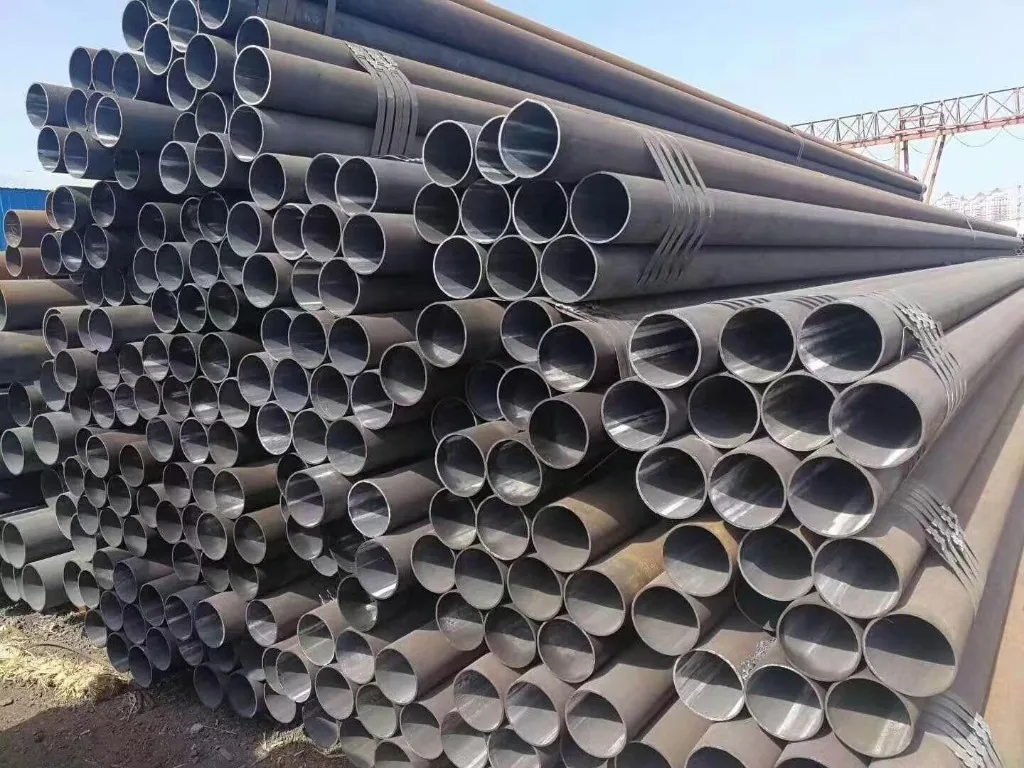
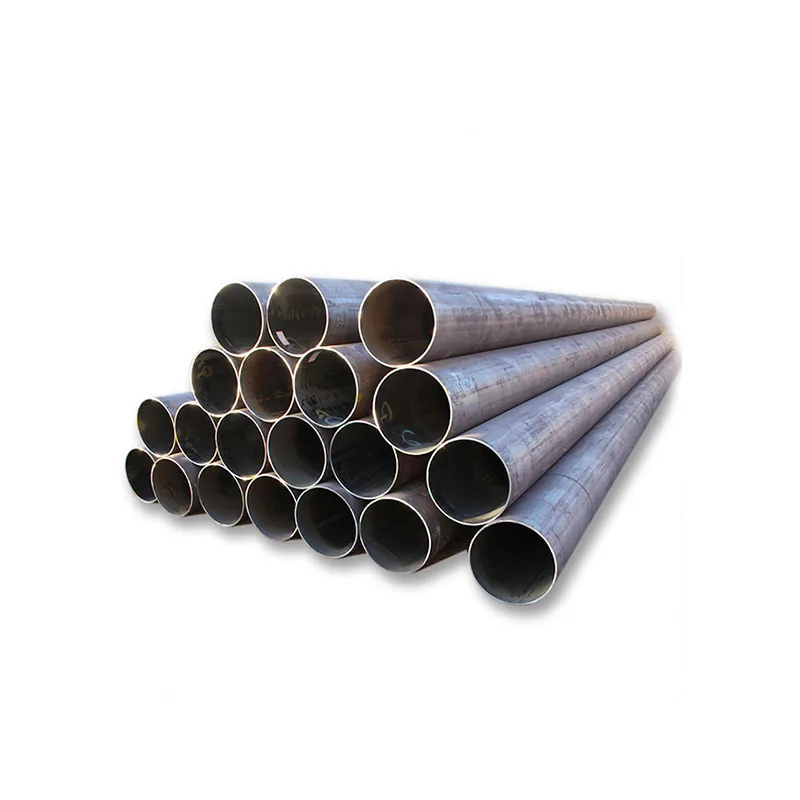
Figure 2: Carbon steel pipe stock displaying uniform wall thickness and certified mill test markings
Custom Value-Added Processing & Global Seaworthy Packaging
Procuring steel pipes from Ironex China is a seamless one-stop experience. Beyond raw mill supply, our processing plant delivers: precision beveling (30°/35° BE), threaded ends with couplings (T&C), custom pipe cutting to exact job-site lengths, black vanish / anti-rust oiling, plastic end cap protectors, and heavy steel strapping in hexagonal bundles. For marine shipping, we utilize waterproof tarpaulins, desiccant bags, and sturdy wooden dunnage to eliminate transit rust. Whatever your destination port in Asia, the Middle East, South America, or Africa, Ironex guarantees prime mill condition upon arrival.
5. Conclusion: How to Specify & Partner with Ironex China
In summary, choose seamless steel pipe when your design involves extreme pressure, critical toxic/combustible hydrocarbon transit, high-temperature boilers, or zero-leakage hydraulic systems. Choose welded steel pipe when executing large-diameter water pipelines, structural columns, low-to-medium pressure utility lines, or budget-constrained municipal works.
Request Mill-Direct Steel Pipe Quotations from Ironex China
Whether your bill of quantities calls for 50 tons of ASTM A106 Gr. B seamless boiler pipes or 2,000 tons of API 5L LSAW/SSAW line pipe for a regional water pipeline, Ironex China provides verified mill certifications (EN 10204 3.1), competitive factory-gate pricing, and fast export fulfillment.
Ironex China Quality Commitment
All steel materials are supplied with authoritative Mill Test Certificates (EN 10204 3.1 / 3.2), full ultrasonic inspection (UT), third-party SGS/BV inspection support, and specialized maritime export packaging.
Featured Steel Materials for This Subject
Need Exact Technical Specs or Fast Pricing?
Contact our metallurgical engineering team for custom thickness, tolerance control, and sea-freight packaging solutions.